



AI-driven workflow automation and orchestration enable faster decisions, greater efficiency, and scalable operations. By combining automation with AI, workflows become adaptive, data-driven, and capable of preventing failures – making them essential for modern businesses.
In this article, I’ll explain everything you need to know about AI-driven workflow automation and AI-driven workflow orchestration. I’ll cover why they’re important, how they work, the challenges they present, and best practices for success.
Organizations are always looking for ways to streamline their operations and automate their processes in this ever-changing technological world. One way of achieving this is through workflow automation and workflow orchestration – processes that many organizations already have in place.
And now, with the continuous rise of artificial intelligence (AI), these processes can be improved upon even further. In fact, without the use of AI, workflow automation and orchestration can become rigid and lead to real-time failures in complex scenarios.
So, integrating AI into workflows is not just a ‘nice to have’. It enhances business process efficiency and effectiveness for organizations while also enabling faster decision-making and business expansion. It also helps to prevent the aforementioned risk of failures.
I’ll explain everything you need to know in this article. Let’s start by looking at workflow orchestration.
What is workflow orchestration?
Workflow orchestration involves the coordination of multiple automated processes, like systems, people, and data. Done correctly, this results in a process being executed efficiently and with minimal human effort.
This has never been more important than in the fast-paced world of today. After all, to be efficient, you should be able to not only work faster, but also smarter and at scale. So, the benefits of workflow orchestration are numerous, including improved visibility and complex business processes becoming easier to scale.
Also consider how, more often that not, work is spread across multiple tools, systems, and teams. That makes orchestration even more crucial to the management and coordination of all aspects of a workflow. Orchestration considers the relationships between processes and how they interact with each other – unlike simple automation, which focuses on completing tasks in isolation.
Additionally, orchestration enables organizations determine the order, relationships, dependencies, and timing of tasks so that they work seamlessly and intelligently.
What is AI-driven workflow automation?
AI-driven workflow automation involves integrating AI into the operations of an organization, allowing specific tasks (or even entire sequences of work) to be completed automatically and efficiently.
It takes advantage of machine learning (ML) and agentic AI to understand context-specific information and learn from historical data, allowing it to make intelligent decisions in real-time.
Can workflow orchestration be driven by AI, too?
Yes! Utilizing AI for workflow orchestration is the smart way to manage a combination of AI models, agents, data pipelines, and application software to automate complex business operations.
It can enable systems to manage unstructured data, adapt to dynamic conditions in real time, and even make autonomous decisions if need be.
This is because AI-driven orchestration uses real-time data to identify key performance indicators (KPIs) for each microservice for ultimate decision-making. Put simply, tasks can be redirected, and infrastructure resources can be added, when needed.
With the continued adoption of decentralized data management, the implementation of AI-driven orchestration also impacts static application programming interface (API) gateways, turning them into intelligent routing systems. AI can automate decision-making processes, predict where bottlenecks may occur, and provide self-healing capabilities.
Historically, workflow orchestration was carried out with API gateways like Ocelot. It would manage the routing of requests to multiple microservices, while caching those responses and providing rate limiting functionality.
As more organizations deploy (hundreds of) services with increasing levels of complexity, the traditional methods of manually orchestrating these services simply cannot keep up with their dynamic environments. These include dynamic load changes, service failures, and inter-dependencies between services.
However, that’s not to say the use of AI makes everything perfect, as we discuss next.
What are the key challenges of AI-driven workflow orchestration?
Some key challenges of AI-driven workflow orchestration include:
- Data quality challenges because of incomplete or inconsistent data.
- Integration complexity with legacy platforms and rigid architectures.
- Governance and compliance issues.
- Bias in training data.
Protect your data. Demonstrate compliance.
How does AI-driven workflow automation work?
So, we’ve established what AI-driven workflow automation and AI-driven workflow orchestration are. Now, let’s focus on AI-driven workflow automation, and how it actually works.
AI-driven workflow automation consists of a self-learning feedback loop. This loop comprises a system that takes input, analyzes it with a machine learning algorithm, produces an output/decision based on that analysis, and then sends that output (or result) back to the system to ‘retrain’ the ML algorithm.
Here’s exactly how AI-driven workflow automation works, step-by-step:
- Data collection: Raw data is gathered from the data stores.
- Data processing: Once the data has been collected, it’s cleaned and transformed to a format that makes it compliant for use by AI algorithms.
- Decision-making: Once the data has been refined, it’s analyzed to understand its patterns, and builds decision logic from that.
- Execution: The tasks are executed and the performance is monitored.
- Continuous improvement: The result or outcome of executing the workflow is captured and used to train the machine learning algorithm, thereby improving accuracy over time.
What are the typical stages of an AI-driven workflow?
The AI workflow is an entire system of interrelated components that work together to produce an intelligent outcome.
Shown in the graph below are the typical stages of an AI-driven workflow:
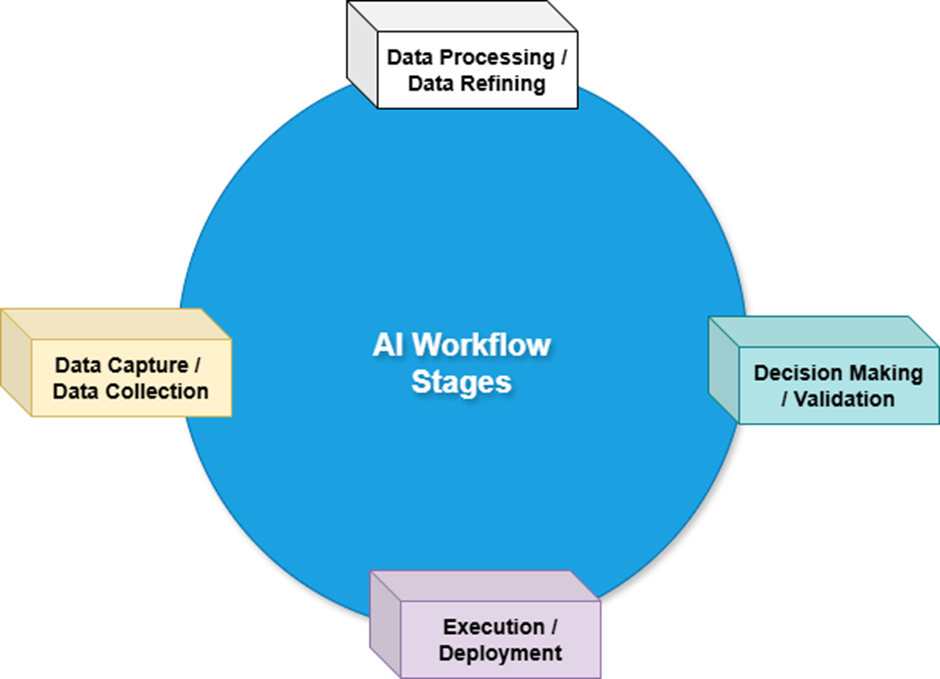
Now, let’s look at these stages more in detail.
Data collection and preparation
This component establishes the foundation on which any AI system operates. Remember that AI cannot operate properly or accurately without high-quality data! Hence, the data collection and preparation component collects data from multiple sources, and then cleans and prepares the data in a format the AI model can use.
AI algorithms and machine learning (ML) models
This component is the “brain” of the entire system. The machine learning model is an algorithm trained to scan for, and identify, patterns in the data, build predictive models from them, and classify them. The ML model is the component that takes the prepared data and processes the data to return intelligent insights.
Natural language processing (NLP)
Natural language processing (NLP) is a sophisticated AI technology that allows a user to communicate with a computer program using their voice (or spoken language), and have that same command translated into a computer-readable format.
It’s an advanced form of AI that serves as the intermediary between humans and machines by translating human conversation into machine code and back again.
As businesses accumulate vast amounts of data not in conventional file formats – such as email, chat log and traditional documents – NLP allows computers to read and decipher information and context from human language. That’s why so many of today’s organizations leverage NLP to store a vast amount of this unstructured, but valuable, data.
Simply put: NLP provides the ability for a computer to view a human’s voice as data (i.e., an input) and retrieve relevant information or context based on what a human says or writes (i.e., an output).
Automation triggers
Automation triggers and conditions are the means by which a workflow is started. A workflow requires a trigger to be activated for it to start and work. And, the trigger is only executed if the conditions are fulfilled – thereby ensuring that the workflow executes when it is actually supposed to.
Workflow orchestration engine
The workflow orchestration engine directs the entire flow of the workflow – indicating what, when, and how each of the components of the workflow work.
This ensures that data progresses smoothly and accurately step-by-step, and that any dependencies or error handling is managed.
Integration layer (API)
The integration layer (API) comprises the tools that make disparate software applications work together, and serves as the message delivery system that connects them.
AI agents
AI agents are software applications that use the AI’s decision-making capability to act independently of the user.
This is similar to how an advanced chatbot would interact with a user, a bot that updates a database, or a bot that fills out a form through robotic process automation.
AI-driven workflow automation: typical use cases
Here are some of the typical use cases of AI-enabled workflow automation:
- Customer support: routing support tickets, automated answers using agents.
- Enterprise operations: document processing, task assignments, approvals, and case handling.
- Finance: data extraction from invoices.
- Human resources: policy management, employee onboarding.
- IT service management and compliance: automated monitoring, service delivery, and real-time automated resolution of incidents.
Why AI-driven workflows are important now and for the future
Organizations that successfully adopt AI-driven workflow automation and AI-driven workflow orchestration today, will have a competitive edge tomorrow. A hybrid model represents the best of both worlds by combining the productivity of a machine with the creativity of a person.
The future of workflows will include intelligent, adaptive, and self-governing systems. The million-dollar question is whether or not an organization will be prepared to embrace that future when it arrives.
To be successful, organizations require good planning, solid infrastructure, and dedication to continuous learning. The potential benefits of this includes increased efficiency, enhanced customer experiences, and the ability to adapt – and react – quickly to changing business conditions.
That’s exactly why organizations really should consider investing in AI-driven workflows. The potential benefits make the investment more than worth it – and crucially, it’ll keep a company competitive in today’s fast-moving marketplace.
In summary: how AI-driven workflows ensure success
While organizations automate their business processes using AI, they often miss one of the primary determinants for success or failure in this regard – the level of readiness of their data. To enable an algorithm to provide correct and usable data insights, the data should be accurate, accessible, and relevant, i.e., it should be aligned with the business goals of the organization.
When it comes to automating processes, many traditional workflows see exceptions as total failures. The entire process will stop, and then you will have to go through a human to begin again.
AI, on the other hand, will evaluate exactly how processes have been executed in the past – and will then use this data to determine the likelihood of an exception before it occurs, and will proactively manage the situation.
Any events or cases that could create problems downstream are therefore eliminated, and the processes are realigned accordingly, to ensure maximum success.
Overall, AI-driven workflow orchestration helps to cut through workflow complexity, resolve issues quickly, and manage increased workflow demand without human involvement.
Similarly, AI-based workflow automation and AI-driven workflow management enable the maintenance of efficient, effective services, regardless of the number of exceptions and challenges that arise.
Combined, these processes set organizations up for success both now and for the future.
Accelerate and simplify database development with Redgate
FAQs: The benefits of – and how to implement – AI-driven workflows
1. What is AI-driven workflow automation?
AI-driven workflow automation uses artificial intelligence to automate tasks and processes, enabling systems to learn from data, make decisions, and improve performance over time.
2. What is workflow orchestration in AI?
Workflow orchestration in AI coordinates multiple systems, data sources, and tasks to ensure processes run in the correct sequence with minimal manual intervention.
3. What is the difference between automation and orchestration?
Automation focuses on completing individual tasks, while orchestration manages how multiple automated tasks and systems work together within a complete workflow.
4. Why is AI important for workflow automation?
AI makes workflows adaptive and intelligent, allowing real-time decision-making, predictive insights, and reduced risk of process failures.
5. What are the benefits of AI-driven workflows?
Key benefits include increased efficiency, faster decision-making, scalability, reduced errors, and improved customer experiences.
6. What are the challenges of AI-driven workflow orchestration?
Common challenges include data quality issues, integration with legacy systems, governance and compliance concerns, and potential bias in AI models.
7. How does AI improve workflow efficiency?
AI analyzes data, predicts outcomes, and optimizes processes automatically, helping eliminate bottlenecks and improve overall performance.
8. What are common use cases for AI workflow automation?
This document contains proprietary information and is protected by copyright law.
Copyright © 2026 Red Gate Software Limited. All rights reserved








Load comments